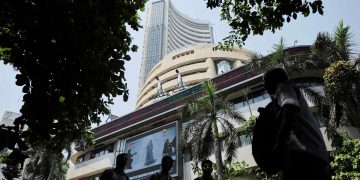





MUMBAI — Shares of India’s Bombay Stock Exchange (BSE) and major brokerage companies like Groww and Angel One dropped between 3% and 7% on Monday, as investors digested the impact of tighter bank lending rules for brokers and market intermediaries.
The new directives on commercial bank lending to capital market intermediaries, released by the Reserve Bank of India after market hours on Friday, include a requirement for there to be 50% collateral for bank guarantees, of which 25% shall be in cash, and a ban on loans for proprietary trading or investments by brokerages on their own account.
The new rules, set to take effect on April 1, will make borrowing from the “bank channel unsuitable for brokers, and they will only use it for short-term mismatches,” analysts at JM Financial Institutional Securities said in a note.Angel One, whose shares were down over 5% in midday trading, would need to diversify into borrowing from commercial paper and nonconvertible debentures, the note said, adding that the company had owed about half of its aggregate borrowings of 34 billion rupees ($375.4 million) to commercial banks as of the end of March 2025.
The higher collateral will increase costs for proprietary trading, which involves trading using a company’s own earnings instead of client funds, analysts at Jefferies wrote in a note. Prop traders make up about half of the total value of premiums and about a third of the cash turnover on equity option trading in India.
The rules come just weeks after the government proposed a hike in the country’s securities transaction tax, pushing up the rate for futures trading from 0.02% to 0.05%, and for options trading from 0.1% to 0.15%.
Jefferies estimated that the rules on prop trading could impact about 10% to 12% of the turnover from options trading, translating to a roughly 10% earnings impact for the BSE. Shares of the BSE were down about 7% in midday trading.
India has for months been trying to cool down what is the world’s largest derivatives market by trading volume. Over the first nine months of 2025, half of the derivatives contracts traded via exchanges worldwide were traded on the BSE and its local peer, the National Stock Exchange (NSE).
Regulators and observers have called out the risks to individual retail traders in India’s derivatives markets, 91% of whom lost money in the fiscal year that ended in March 2025. In July last year, the regulator banned market-making company Jane Street for alleged manipulation of the stock indices underpinning popular options, saying this came at the expense of retail investors. Jane Street has submitted an appeal against that verdict.
The tighter rules also come after the NSE, which has eclipsed the much older BSE as the country’s largest bourse, approved plans for a much-awaited IPO earlier this month after receiving permission from the market regulator.
SOUMYAJIT SAHA